 EuroScrape
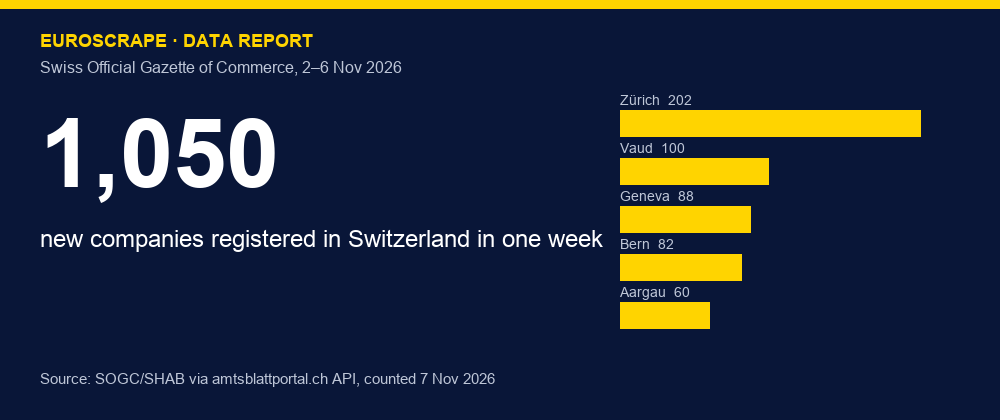
1,050 companies were registered in Switzerland last week, and every one of them was published three days after the fact - reading the Swiss commercial register as open data
Switzerland publishes every entry of its commercial register in the Swiss Official Gazette of Commerce (SOGC, SHAB in German, FOSC in French). Not a summary, not a monthly file: every new company, every change of seat or purpose, every deletion, the morning it becomes official. And since 2018 the gazette has had a public API, documented as “freely accessible for anyone to use”, with no account needed for published notices.
On 7 November 2026 I read the notices of the week of 2–6 November with the Switzerland New Companies Actor, which I had just finished writing. Here is what one week of Swiss company creation looks like.
1,050 new companies in five working days
| Day | New registrations |
|---|---|
| Monday 2 Nov | 191 |
| Tuesday 3 Nov | 181 |
| Wednesday 4 Nov | 207 |
| Thursday 5 Nov | 235 |
| Friday 6 Nov | 236 |
| Saturday, Sunday | 0 (the gazette is not published) |
That is about 210 companies per working day for a country of 9 million people. For comparison, the Spanish BORME published 700 new companies on Friday 6 November for 48 million people, and New York State filed 4,598 in the same week for 20 million. Per capita, Switzerland sits between the two.
Where: Zürich first, then the Lake Geneva arc
| Canton | New companies (2–6 Nov) |
|---|---|
| Zürich | 202 |
| Vaud | 100 |
| Geneva | 88 |
| Bern | 82 |
| Aargau | 60 |
| Zug | 59 |
| Lucerne | 57 |
| St. Gallen | 55 |
| Valais | 47 |
| Thurgau | 45 |
Zug is the interesting line: 59 new companies for a canton of 130,000 people, the same order of magnitude as Bern (1 million people). The low-tax canton keeps attracting holding and trading companies; on Friday alone, 18 of the 236 notices came from Zug, with Cham and Baar (two Zug municipalities) among the eight most frequent seats of the day.
The language split follows the map: 735 notices in German, 276 in French, 39 in Italian.
Which legal form: the GmbH wins, the AG is for the ones with money
On Friday 6 November (236 notices):
| Legal form | Count | Share |
|---|---|---|
| GmbH / Sàrl (limited liability company) | 99 | 42% |
| Sole proprietorship | 78 | 33% |
| AG / SA (company limited by shares) | 35 | 15% |
| Association | 10 | 4% |
| General partnership | 6 | 3% |
| Branch of a foreign company | 4 | 2% |
Swiss law sets the minimum capital at CHF 20,000 for a GmbH and CHF 100,000 for an AG, and founders stick to the minimum: of the 134 companies with a capital on Friday, 96 declared exactly CHF 20,000 and 35 exactly CHF 100,000. The median is CHF 20,000; the total for the day is CHF 5.49 million. Sole proprietorships and associations have no capital, which is why “capital” is filled for only 57% of the rows.
One more field you will not find in most registers: 123 of the 236 companies declared an audit opting-out, the waiver of the limited statutory audit allowed below 10 full-time employees. It is a decent proxy for “small company that intends to stay small”.
The three-day delay, measured
Each notice carries two dates: the day the entry was made in the register journal (journalDate) and the day it was published (publicationDate). For all 236 notices of Friday 6 November, the journal date was Tuesday 3 November: exactly three days, without exception. If you sell to brand-new companies, a Swiss lead is three days old when you can read it. The Spanish BORME takes 7 to 23 days; Texas lists companies about ten days after the charter.
What the notice contains, and what I left out
The XML behind each notice is structured: registered name and its translations, UID (the CHE number), seat, street address, legal form code, business purpose, nominal and paid-in capital, audit opting-out, the register office. The Actor returns all of that as fields.
The notice text also names the founders, partners and managers, with their place of origin and residence. I do not return them. The structured output has no person field, and the optional raw text has the sentences naming people removed. For B2B prospecting the company, its address and its purpose are what you need; the people can be found on the company’s own website once it has one.
Reproduce it
Input of the Actor for the week above (all cantons, new registrations only):
{ "dateFrom": "2026-11-02", "dateTo": "2026-11-06", "eventTypes": ["incorporation"], "maxItems": 2000 }
Zürich, Geneva and Vaud only, last 7 days, 50 rows:
{ "daysBack": 7, "cantons": ["ZH", "GE", "VD"], "eventTypes": ["incorporation"], "maxItems": 50 }
The first 20 companies of every run are free, then $4 per 1,000. Every row links to the official notice and to its XML, so each number above can be checked against the source.
Source: Swiss Official Gazette of Commerce (SOGC/SHAB/FOSC), rubric “Commercial register”, read through the official publications API (amtsblattportal.ch) on 7 November 2026. Counts are of published notices; a company registered in several cantons appears once per publishing register.
Run these numbers yourself. Every EuroScrape Actor runs on Apify, pay per result, first results free. Open the Store page →
EuroScrape Data Letter
Five numbers a week from official registers and public prices, each one reproducible with an Actor. Free, one e-mail on Thursdays.
Archive and unsubscribe: buttondown.com/Euroscrape.